The Sitting Disease
How modern infrastructure became the world's most effective exercise deterrent, and what the 15-minute city movement is doing about it.
In 1967, a British epidemiologist named Jeremy Morris published a now-famous study comparing London bus drivers with bus conductors¹. Drivers sat for most of their shifts; conductors spent the day climbing stairs and moving through the aisles collecting fares.
The difference in heart disease rates between the two groups was dramatic.
It was one of the earliest demonstrations that the structure of daily life — not just intentional exercise — shapes health outcomes.
Half a century later, the conditions Morris observed have scaled to an entire society.
Today, many adults in developed economies move surprisingly little during an average day. A large smartphone-based study tracking 717,000 people across 111 countries found that the global average was just 4,961 steps per day², well below commonly recommended activity levels.
In the United States, the figure sits around 4,774 steps, while some countries average closer to 3,500 steps per day².
For context, health guidelines often describe 7,000–10,000 daily steps as a moderately active lifestyle.
The gap between what our bodies evolved for and how modern life is structured has become large enough that researchers have given it a name: sedentary behaviour, sometimes informally referred to as “the sitting disease.”
The interesting question isn’t why individuals don’t exercise enough.
The more interesting question is why entire environments have become so effective at eliminating movement from everyday life.
How Movement Disappeared from Daily Life
For most of human history, physical activity was not a separate category of behaviour. It was simply embedded in daily routines.
Work required movement. Shopping required walking. Social life required leaving the house.
Over the past century, that structure has gradually inverted.
Cars replaced walking for short trips. Office work replaced manual labour. Digital communication replaced many forms of in‑person interaction. And the smartphone increasingly replaced activities that once required leaving the house entirely.
The result is a lifestyle where movement has to be deliberately scheduled rather than naturally occurring.
Urban design plays a major role in this shift.
Studies consistently show that the number of steps people take each day varies dramatically between countries and cities. The differences often correlate not with culture, but with transport systems and urban layout.
Car-dependent environments — especially suburban developments designed around driving — dramatically reduce incidental walking. In contrast, cities built around public transport, cycling infrastructure, and dense neighbourhoods tend to produce higher daily activity levels³.
In other words: movement is not simply a personal habit. It is an environmental side effect.
When the built environment removes opportunities for incidental walking, exercise becomes something that must be added back in artificially.
The gym is, in some sense, the architectural consequence of that removal.
The Infrastructure of Sedentariness
Once you start looking at modern environments through this lens, a pattern emerges.
Many of the systems that define contemporary life quietly optimise for convenience through immobility.
Consider a typical day in a car-oriented city.
You leave your house through the garage.
Drive to work.
Sit at a desk.
Drive to a shop.
Order food through an app.
Watch entertainment through a screen.
At no point is walking required.
Individually, each of these innovations made life easier. Collectively, they created a landscape where movement has been engineered out of the background of daily life.
Transportation infrastructure is particularly influential.
Research shows that in parts of Europe, between 12% and 30% of daily trips are walked, while in many car-dependent regions the number is significantly lower. (See notes 3&4)
Where daily destinations are reachable on foot, walking happens naturally. Where they are not, it disappears almost entirely.
This dynamic has led urbanists to a simple observation:
If environments shape behaviour, then health outcomes may be partially designed into cities themselves.
The Return of the Walkable City
Over the past decade, a growing urban planning movement has begun addressing this problem directly.
Its most widely discussed concept is the 15‑minute city⁵.
Popularised by urbanist Carlos Moreno and adopted in varying forms by cities including Paris, Melbourne, and Portland, the idea is deceptively simple:
Daily needs — work, groceries, schools, parks, healthcare — should be reachable within a 15‑minute walk or bike ride from home.
The goal is not to eliminate cars entirely. It is to redesign neighbourhoods so that movement becomes a natural byproduct of daily life again.
Paris provides one of the clearest examples. Over the past several years the city has expanded cycling infrastructure, pedestrianised large areas of the urban core, and encouraged mixed-use neighbourhood development that places housing, services, and workplaces closer together.
The result is not simply a transportation shift.
It is a subtle reintroduction of incidental movement — the kind that once filled ordinary days without anyone needing to think about it.
Other cities are experimenting with related approaches:
Superblocks in Barcelona, which restrict through-traffic to create pedestrian-first neighbourhood interiors
Low-traffic neighbourhoods in the UK, designed to discourage car shortcuts through residential streets
Cycling-first infrastructure in Copenhagen and Amsterdam, where commuting by bike is often the fastest option
Each initiative approaches the problem from a different angle, but the underlying logic is the same:
If environments quietly shape behaviour, then better environments can quietly improve it.
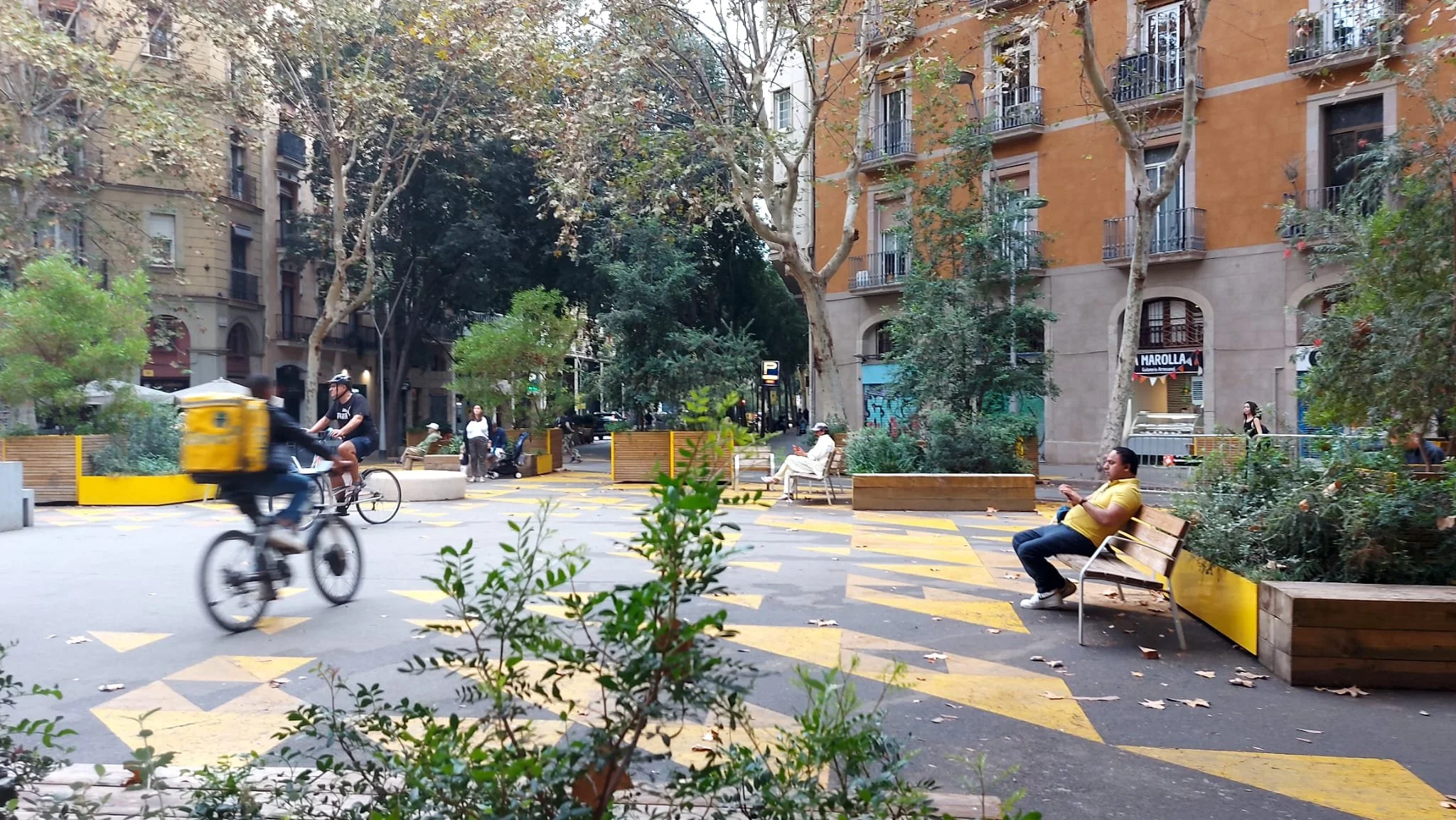
Barcelona Superblock San Antoni
Designing Movement Back into the System
What makes these urban initiatives interesting is that they treat physical activity not as a personal discipline problem, but as a systems design problem.
Not friction that serves the platform — but friction that supports the user’s own intentions.
Instead of asking people to exercise more, they ask a different question:
What would happen if movement were the easiest option again?
Historically, this was the default.
People walked because walking was simply how things worked.
Modern infrastructure disrupted that equilibrium by optimising for speed, distance, and efficiency. The unintended side effect was the quiet removal of physical activity from the background of daily life.
The emerging generation of urban design experiments — from 15‑minute cities to pedestrian-first neighbourhoods — can be understood as attempts to rebalance that system.
Not by banning cars or mandating fitness.
But by reshaping the environment so that movement returns to its original role: a small, invisible part of everyday life.
Notes & References
Morris, J. N., and P. A. Raffle. “Coronary Heart Disease in Transport Workers; a Progress Report.” British Journal of Industrial Medicine, vol. 11, no. 4, 1954, pp. 260–264. https://doi.org/10.1136/oem.11.4.260. Reports early occupational epidemiological evidence that bus drivers had higher rates of coronary heart disease than bus conductors, who were more physically active during work. The paper contributes to early hypotheses linking physical activity levels and cardiovascular health outcomes in occupational settings.
Althoff, Tim, et al. “Countrywide Natural Experiment Links Built Environment to Physical Activity.” Nature, vol. 645, no. 8080, 2025, pp. 407–413. https://doi.org/10.1038/s41586-025-09321-3. Uses large-scale smartphone-based step-count and mobility data combined with quasi-experimental relocation analysis to estimate changes in physical activity following moves to different built environments. Finds that relocating to more walkable areas is associated with increases in daily steps, supporting a relationship between urban form and physical activity behaviour.
Sallis, James F., et al. “Physical Activity in Relation to Urban Environments in 14 Cities Worldwide: A Cross-Sectional Study.” The Lancet, vol. 387, no. 10034, 2016, pp. 2207–2217. https://doi.org/10.1016/S0140-6736(15)01284-2. Cross-sectional study across 14 cities showing associations between objectively measured physical activity and built environment characteristics such as walkability, street connectivity, and access to destinations. Finds that more walkable environments are consistently associated with higher levels of physical activity, though causality is not established due to study design.
Ewing, Reid, and Robert Cervero. “Travel and the Built Environment: A Meta-Analysis.” Journal of the American Planning Association, vol. 76, no. 3, 2010, pp. 265–294. https://doi.org/10.1080/01944361003766766. Meta-analysis synthesising evidence on relationships between built environment characteristics (including density, land-use mix, and street design) and travel behaviour. Finds consistent associations between urban form and outcomes such as vehicle miles travelled and walking, with varying effect sizes across studies.
Moreno, Carlos, et al. “Introducing the ‘15-Minute City’: Sustainability, Resilience and Place Identity in Future Post-Pandemic Cities.” Smart Cities, vol. 4, no. 1, 2021, pp. 93–111. https://doi.org/10.3390/smartcities4010006. Conceptual and policy-oriented paper introducing the 15-minute city framework, proposing that urban services should be accessible within short travel times to improve sustainability, resilience, and quality of life. The paper is primarily theoretical and normative, outlining principles rather than testing empirical outcomes.
